English


'The school is ambitious for every pupil. This starts with reading. Staff are experts in teaching phonics and early reading. They check regularly to ensure that pupils keep up. Those that are struggling are given the appropriate support through interventions that enable them to catch up. Staff carefully select reading books that match pupils’ stage of development. As pupils become more confident, they gradually move to reading rich quality texts that focus on comprehension and the skills needed to become a fluent reader.'
Ofsted October 2024
Reading Intent:
All Children will leave our school being able to read and will develop a love of reading.
Every adult is determined that this will be achieved
We achieve this through using the Read Write Inc. Phonics scheme (RWI), where children learn to read accurately and fluently with good comprehension. This scheme meets the expectations outlined in the both the Early Years Foundation Stage and the National Curriculum. For more information follow the links at the bottom of the page.
We have 5 core principles to teaching and learning to read:
- Children must know the purpose of their lesson - the one thing they should be thinking about.
- Staff will be passionate about teaching reading - so children will be engaged emotionally.
- Reading will be taught at an effective pace - so every moment of each lesson is devoted to learning to read.
- Every child participates throughout the lesson. Partner work is fundamental to learning.
- Praise effort and progress - not ability.
The RWI routines and signals are used consistently across the whole school, throughout the whole day.
Reading Implementation:
When children begin to learn to read, they are taught two things:
1) To blend the sounds into words (we call this Fred Talk and it is a vital stage necessary for learning to read)
2) To recognise the sounds in the English alphabetic code - the 150+ letters that represent 44 speech sounds.
These sounds are split into 3 Sets: Set 1; Set 2; Set 3.
High frequency words that are not phonically regular are taught as 'tricky' words (we call them Red Words) and are practised frequently.
Reading books (to read in home and in school) are closely matched to children's knowledge of sounds and 'tricky' words, so that early on, they experience plenty of success.
Children need to read their book a minimum of three times.
1st read: accuracy - children focus on accurate word reading ('Fred Talk')
2nd read: on developing fluency
3rd read: reading like a storyteller, so they are able to develop comprehension of what they are reading.
Fluency and comprehension increase with each repeated reading. Each half-term the children are assessed and grouped according to their phonic ability. Children are offered interventions to ensure they keep up with the number of sounds and words they can read.
Beyond RWI
Once the children have completed the RWI Phonics programme, they will be taught the RWI Comprehension programme. This develops children's reading fluency, comprehension of and response to fiction and non-fiction texts and aims to improve children's writing by developing their vocabulary, grammar and spelling knowledge.
Library Books
Every child will visit the school library each week to develop their love of reading. Their choice of book is for them to share at home and have it read to them.
Get Caught Reading
In Discovery time, children can be 'caught' reading, put on 'reading wings' and put their name in the pot. A name is pulled out of the pot each week during Celebration Assembly, and the winner gets to choose a book to take home and keep.
In Year R (Early Years Foundation Stage), we have an aspiration linked to Reading:
Phonics Screening Check
All children nationally in Year 1 are required to take the Phonic Screening Check in June. Children may retake this test in Year 2 if they do not meet the required pass mark. Click the powerpoint below for more information.
Talk Through Stories
Talk Through Stories is a vital addition to our English curriculum, designed to extend and deepen children’s vocabulary so that they can understand the books they will soon be able to read for themselves. We chose stories that we believe are worth reading and re-reading – stories that children will love. We include old favourites such as Dogger by Shirley Hughes, Burglar Bill by Janet and Allan Ahlberg, Can’t You Sleep, Little Bear? by Martin Waddell and Where the Wild Things Are by Maurice Sendak. We also include more recent literature, such as Hugless Douglas by David Melling, Perfectly Norman by Tom Percival, I’m in Charge by Jeanne Willis, Billy and the Beast by Nadia Shireen, Anna Hibiscus by Atinuke. Our stories reflect our diverse Wootey Community.
Our volunteers give children one-to-one reading support on a weekly basis, boosting their literacy skills,
confidence, and reading fluency. We’re proud to be a partner school, able to provide our
pupils with this valuable extra reading time each week!
Damian Hinds visited our school to see how our 'Schoolreader' volunteers help every child to leave our school being able to read.


10 Top Tips for Reading Stories To Your Child
Writing Intent:
All Children will leave our school being able to write
and every adult is determined that this will be achieved
We achieve this through using the Read Write Inc. Phonics scheme (RWI), where children learn to write accurately and fluently.
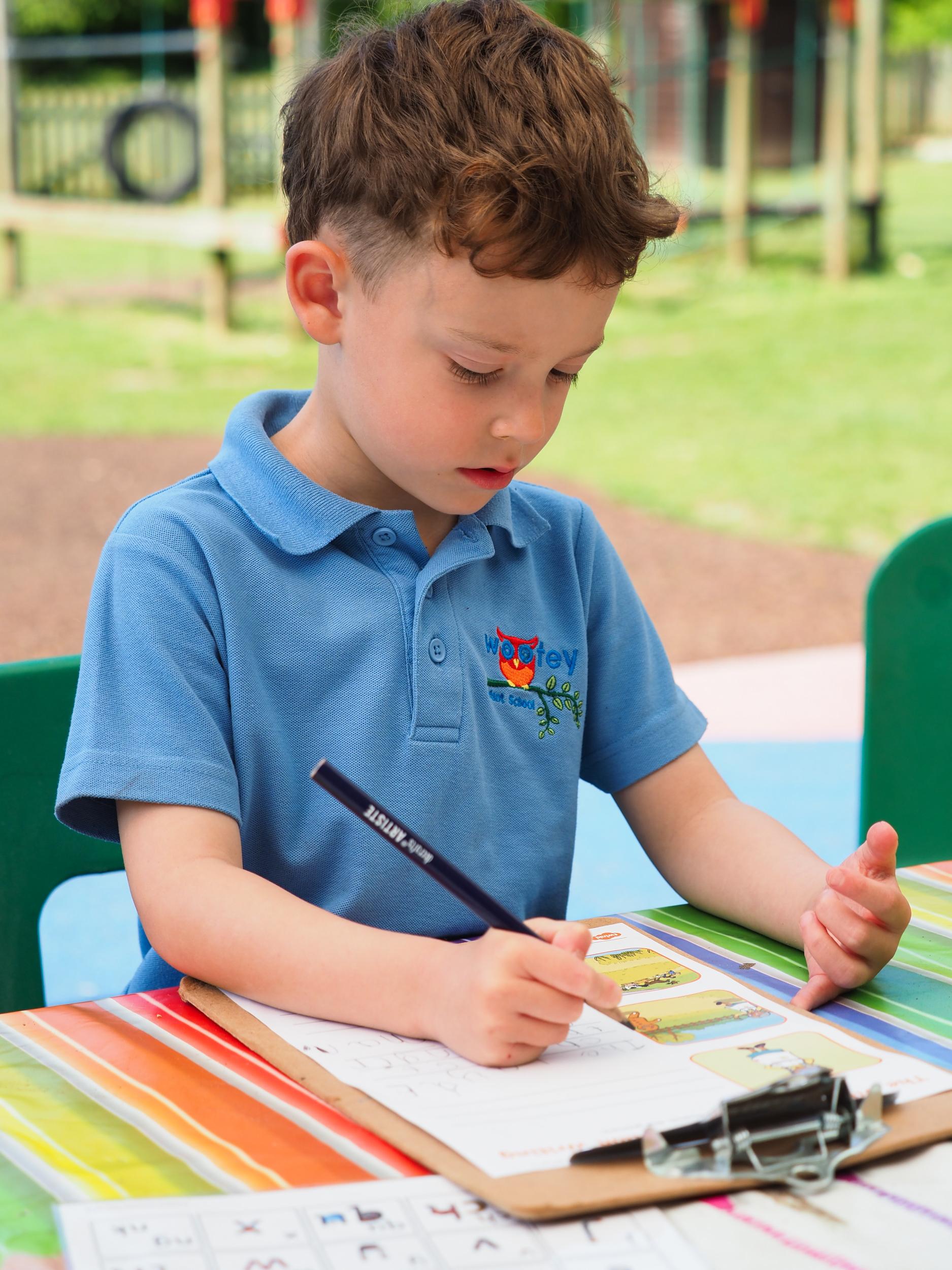
As with Reading, the alphabetic code is embedded first, so that the children can write simple words early on and build on their success. The children write every day, rehearsing out loud what they want to write, and composing sentence by sentence, until they are confident enough to write independently.
They write at the level of their spelling knowledge: that is, they use their knowledge of the alphabetic code and the 'tricky' words they have learnt.
Writing Implementation:
Transcription
Children learn to:
- develop a confident handwriting style
- spell common words with common graphemes and suffixes
- spell common words with unusual grapheme ('tricky' words)
- write sentences with correct letter formation, spelling and punctuation.
Composition
Children learn to:
- build and rehearse their own sentences based on ideas from the story
- apply new grammar concepts linked to the story
- use new vocabulary in their writing
- edit their writing to correct their grammar and punctuation
When learning Set 1 sounds, children are taught handwriting phrases to help them remember correct formation.
Handwriting is taught in RWI lessons, as well as a daily class based handwriting session. Expectations for handwriting are outlined in the Wootey Schools Handwriting policy.
Children are taught to spell 'tricky' and common exception words. The children in Years 1 and 2 also have half termly spelling test. We highlight the first 10 errors and children are encouraged to practise spelling these words in school and at home.
Impact
We are very proud of the outcomes that the children in every year group achieve and are regularly wowed by the maturity and complexity of thinking that they demonstrate. We are confident that this quality is a result of the clear links made in every year group between speaking and listening, phonics, spelling, reading and writing combined with the motivation and engagement that the children feel when they are immersed in learning journeys with rich links across subjects. This truly is a curriculum for the children of Wootey Infants which sets them up very well for their journey into KS2.
RWI Silent Signals
Silent Signals prevent cognitive overload:
Children are praised for routines they do quickly and quietly.
Stop signal: helps us stop in a calm manner, ready for what's next.
Turn to your partner signal (TTYP): partner work is used consistently in all lessons.
My turn, your turn (MTYT) signal: this silent signal is used when children are required to repeat something after the teacher.
1,2,3 signal: one finger held up (children stand); two fingers (children walk to the desired area); three fingers (children sit down).
Silent handwriting signal: this sign indicates that children sit with their feet flat on the floor; bottom at the back of the chair; body one fist from the table; shoulders down and relaxed; one hand holding their page; back leaning forward slightly; other hand holding a pencil, ready in a tripod grip.
Curriculum Links-
Further Foundation Stage Curriculum guidance:
https://www.gov.uk/government/publications/early-years-foundation-stage-framework--2
Reading in Years 1 and 2 (Key Stage 1)
The National Curriculum for pupils in Key Stage 1: